



 0752-2228195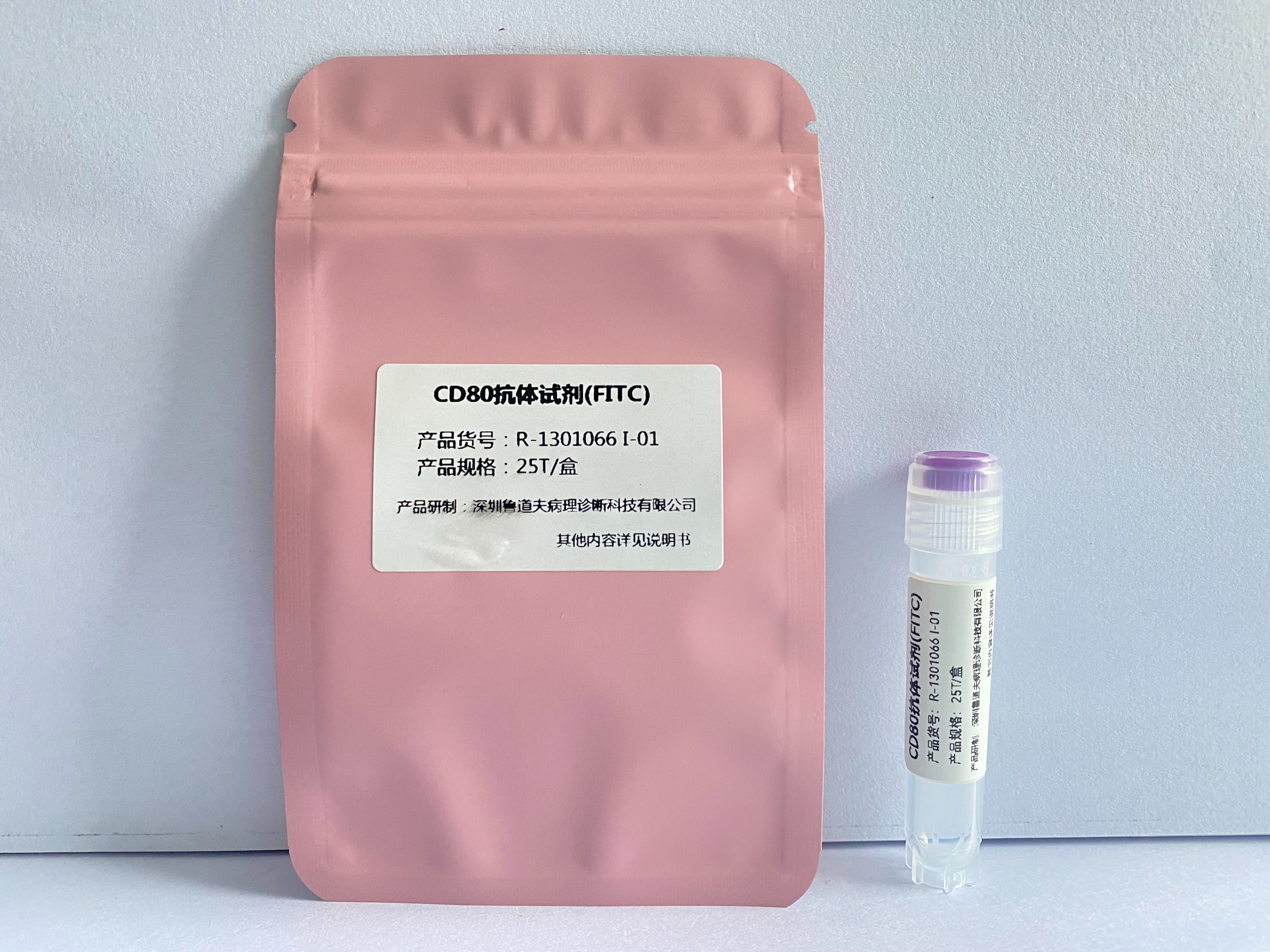
CD80 antibody reagent (FITC)
Wholesale Price(RMB):
6841504
Product Code:R-1301066Ⅰ-01/R-1301066Ⅰ-02
Applicable Scenarios:For scientific use only.

6841504
| Product Name | Anti-Human CD80 , FITC Assay Kit |
|---|---|
| Target | CD80, B7-1 |
| Label | FITC |
| Instrument | Flow cytometer compatible with 488nm laser |
| Subtype | Mouse IgG1, κ |
| Clone Number | 2D10.4 |
| Recommended Application | Flow cytometry |
| Dosage | 5 μL (1 μg)/Test |
| Purification | Affinity chromatography |
| Stock Solution | Phosphate buffer solution containing 0.2% BSA and 0.09% NaN3 (pH7.2) |
| Storage Conditions | Store at 2 - 8℃, protect from light, do not freeze |
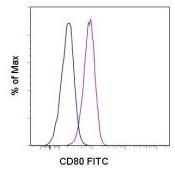
Fig.-results of Daudi cell staining, purple anti-human CD 80 and FITC (clone: 2d10.4), and blue results of isotype control and FITC.
Overview of CD80 molecular target information
Molecular name: CD80, CD80 molecule
Gene family: CD molecules; V-set domain containing; C2-set domain containing; B7 family
Alias: B7.1; B7-1
Former name: CD28LG; CD28LG1
Full name: b-lyric activation antigen B7; CD80 antigen (CD28 antigen ligand 1, B7-1 antigen); CD80 molecule
Review of CD80 molecular targets
Antigen differentiation cluster 80(CD80) is a protein found in dendritic cells, activated B cells and monocytes, which provides necessary co-stimulation signals for T cell activation and survival. It is also called B7-1. The cDNA of B7-1 is predicted to be a type I membrane protein, which is synthesized on the signal peptide translocated on the endoplasmic membrane. It is predicted that protein contains two extracellular domains, which are similar in structure to Ig, hydrophobic transmembrane domain and short cytoplasmic domain. CD80 and CD86 genes encode B7-1 and B7-2, respectively, which are similar members of immunoglobulin superfamily expressed on various hematopoietic cell types. B7-1 and B7-2 provide costimulatory signals to T cells by interacting with CD28 and CTLA4.



Copyright: Shenzhen Rudolf Pathological Diagnosis Technology Co., Ltd