



 0752-2228195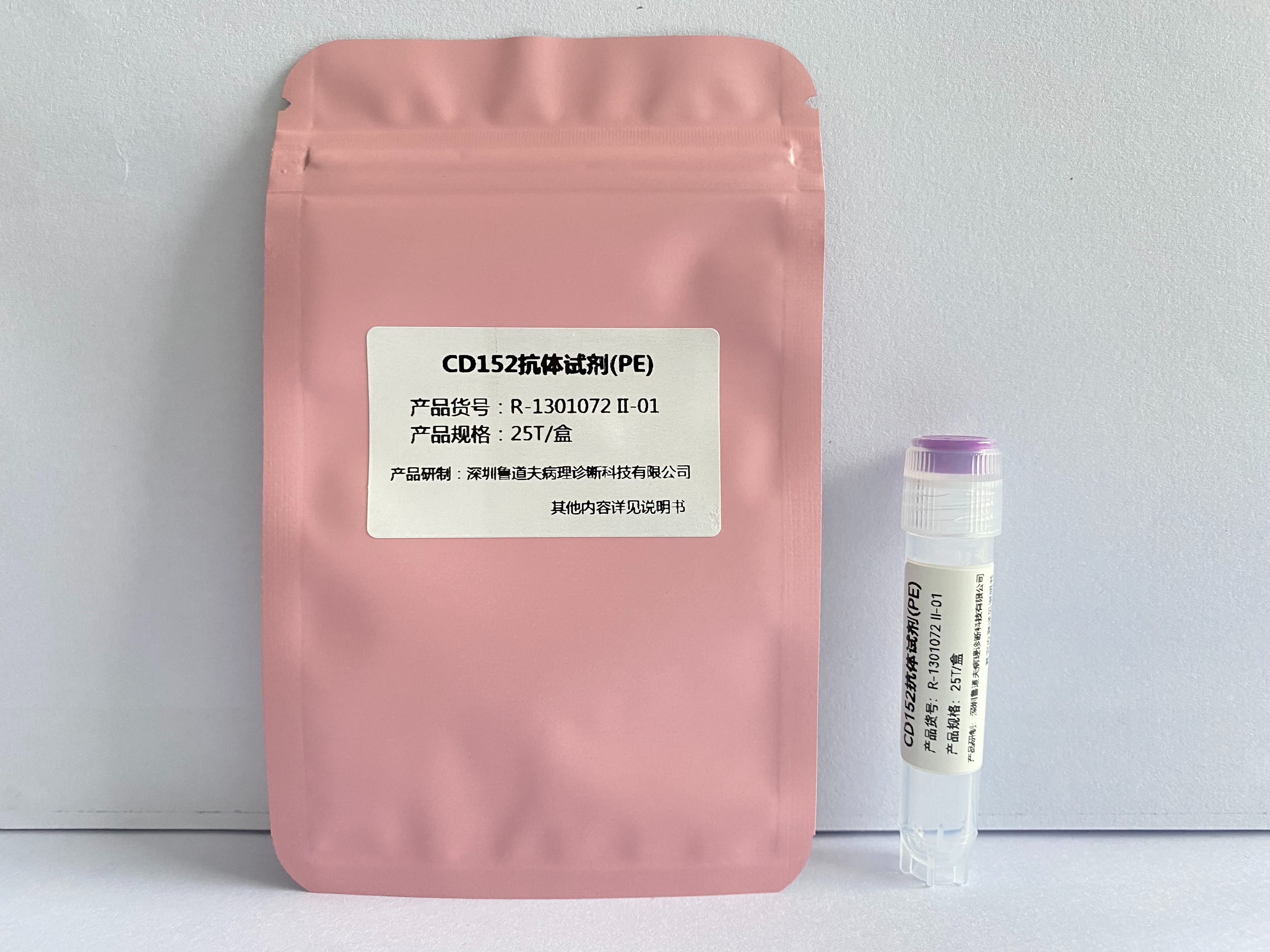
CD152 antibody reagent (PE)
Wholesale Price(RMB):
7981755
Product Code:R-1301072Ⅱ-01/R-1301072Ⅱ-02
Applicable Scenarios:For scientific use only.

7981755
| Product Name | Anti-Human CD152 ,PE Flow Cytometry Antibody |
|---|---|
| Target | CTLA4, CD152, GSE |
| Label | PE |
| Instrument | Suitable for flow cytometers with 488nm, 532nm, 561nm lasers |
| Subtype | Mouse IgG2a, κ |
| Clone Number | BNI3 |
| Recommended Application | Flow Cytometry |
| Dosage | 5 μL /Test |
| Purification | Affinity Chromatography |
| Stock Solution | Phosphate buffer solution (pH7.2) containing 0.2% BSA and 0.2% proclin 950 |
| Storage Conditions | Store at 2 - 8℃, protect from light, do not freeze |
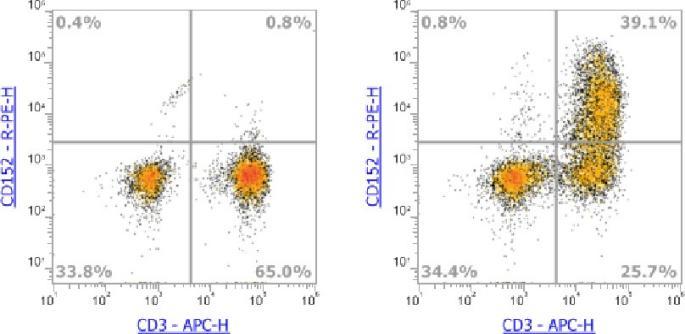
Fig.-The results of Anti-Human CD3, APC and Anti-Human CD152, PE (Clone: BNI3) staining in the control group (left) which was not stimulated by human heparin anticoagulation and the experimental group (right) which was blocked by PMA/Ionomycin overnight. Adhesion cells have been excluded.
Overview of CTLA4 molecular target information
Molecular name: CTL A4, cytotoxic T-lympocyte associated protein 4.
Gene family: CD molecules; V-set domain containing
Alias: CD152; CD; GSE; CTLA-4
Former name: CELIAC3; IDDM12
Full name: celiac disease 3; insulin-dependent diabetes mellitus 12
Summary of molecular targets of CTLA4
Cytotoxic T lymphocyte associated protein 4 (CTLA-4), also known as CD152, is a member of immunoglobulin superfamily and expressed on the surface of helper T cells. CTLA-4 is similar to the costimulatory protein CD28 of T cells, and both of them bind to CD80 and CD86. CTLA-4 transmits inhibitory signals to T cells, while CD28 transmits stimulating signals. CTLA-4 can function as an immune checkpoint, down-regulate the immune system, and act as a "off" switch when it binds to CD80 or CD86 on the surface of antigen presenting cells. Intracellular CTLA-4 also exists in regulatory T cells, which is important for their function. The gene mutation is related to insulin-dependent diabetes, hyperthyroidism, Hashimoto's thyroiditis, celiac disease, systemic lupus erythematosus, thyroid-associated ophthalmopathy, primary biliary cirrhosis and other autoimmune diseases. The polymorphism of CTLA-4 gene is related to autoimmune diseases such as autoimmune thyroid diseases and multiple sclerosis, but the correlation is usually weak. In systemic lupus erythematosus (SLE), it is found that the splicing variant of soluble CTLA-4 is abnormally produced and exists in the serum of patients with the disease.




Copyright: Shenzhen Rudolf Pathological Diagnosis Technology Co., Ltd