



 0752-2228195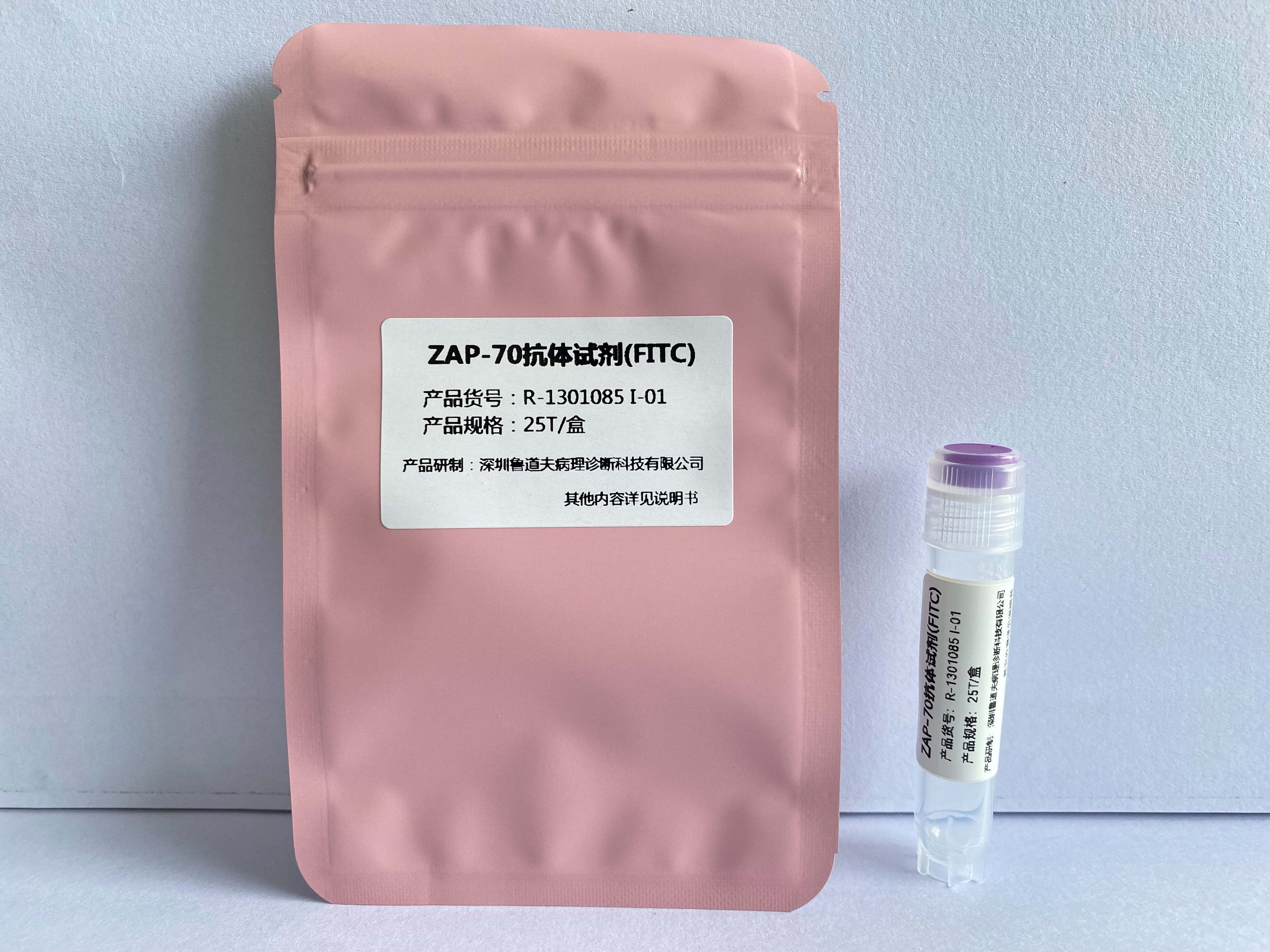
ZAP-70 antibody reagent (FITC)
Wholesale Price(RMB):
7441641
Product Code:R-1301085Ⅰ-01/R-1301085Ⅰ-02
Applicable Scenarios:For scientific use only.

7441641
| Product Name | Anti-Human ZAP-70, FITC Assay Kit |
|---|---|
| Target | ZAP70, STD, SRK |
| Label | FITC |
| Instrument | Flow cytometer compatible with 488nm laser |
| Subtype | Mouse IgG1, κ |
| Clone Number | 1E7.2 |
| Recommended Application | Flow cytometry |
| Dosage | 5 μL /Test |
| Purification | Affinity chromatography |
| Stock Solution | Phosphate buffer solution (pH7.2) containing 0.2% BSA and 0.2% proclin 950 |
| Storage Conditions | Store at 2 - 8℃, protect from light, do not freeze |

Fig.-The results of anti-human ZAP-70 and FITC (clone: 1E7.2) staining on human peripheral blood after anti-human CD3 and PE staining. The lymphocyte in FSC/SSC was gated for analysis.
Overview of ZAP70 molecular target information
Molecular name: zap70, zeta chain of t cell receiver associated protein kinase 70.
Gene family: SH2 domain containing; Syk family tyrosine kinases
Alias: ZAP-70; STD
Used name: SRK
Full name: tyrosine-protein kinase ZAP-70; SRK
Review of ZAP70 molecular targets
TCR-related protein -70, expressed in T cells and NK cells, is necessary for TCR signal transmission and development. ZAP-70 interacts with TCR complex by binding to ITAMs existing in the invariant subunit of TCR complex. After activation, ZAP-70 is phosphorylated on several tyrosine residues through two mechanisms: autophosphorylation and trans phosphorylation of Src family tyrosine kinase Lck1-3. Tyrosine phosphorylation of ZAP-70 is related to its increased kinase activity and triggers downstream signal events. Although ZAP-70 is usually expressed in T cells and NK cells, several recent studies also show that the positive expression of ZAP-70 is highly correlated with the expression of mutant IgVH in B chronic lymphoblastic leukemia (CCL). In a word, the expression of ZAP-70 can be measured by intracellular flow cytometry, which can be used as a prognostic indicator of B-CLL.




Copyright: Shenzhen Rudolf Pathological Diagnosis Technology Co., Ltd