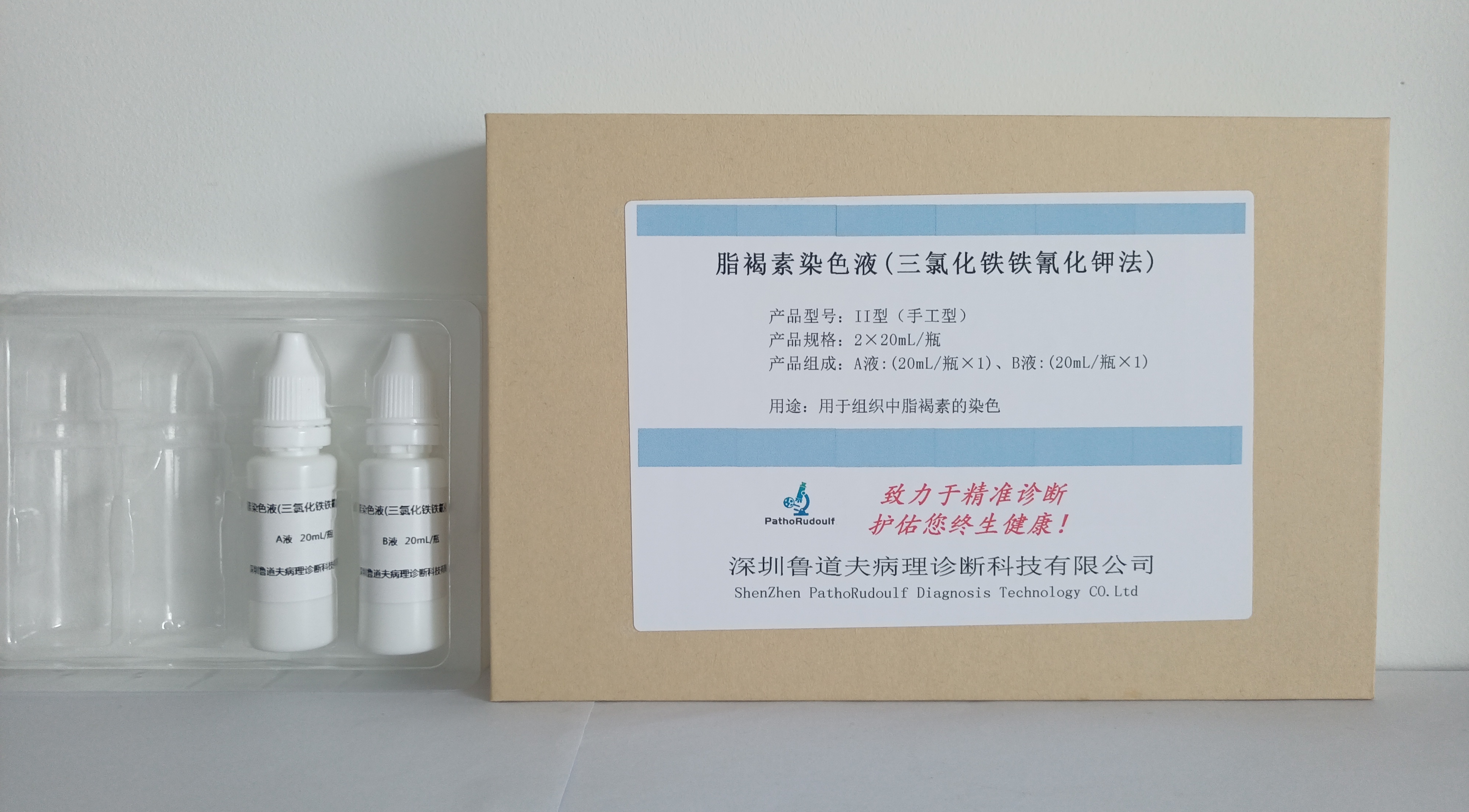
Lipofuscin is a tawny pigment with a granular shape, consisting of fat-containing residues and lysosomal digests, and is thought to be produced by the oxidation of lipids and lipoproteins. The oxidation process occurs slowly and progressively, and therefore the pigment exhibits different staining reactions, different colors, and variations in shape and size, and can be seen in the liver, kidneys, myocardium, adrenal glands, nerve cells, and ganglion cells, etc., and is most often Lipofuscin can be found in liver, kidney, heart muscle, adrenal gland, nerve cells and ganglion cells, etc. It is mostly distributed around the nucleus. Lipofuscin can be divided into early lipofuscin and late lipofuscin. Early lipofuscin has all the characteristics of lipids, and it can be stained gray-black by Sudan black B method; late lipofuscin is a pigment after complete oxidation, which has lost its sultanophilicity, but it has greater reducing power, and it can be shown by Schmorl's high iron - ferricyanide reduction method; the commonly used methods for staining lipofuscin at present include the PAS method, Schmorl's high iron - ferricyanide reduction method, GCF method, PAS method and PAS method, which are used for staining lipofuscin. Schmorl high iron - ferricyanide reduction method, Gomori aldehyde complex red method and so on. Melanin belongs to non-hematogenous endogenous pigment, is a group of pigments whose color ranges from light brown to black, and this pigment is usually found in the nigra and hair follicles of the skin, eyes, and brain, and it is a very stable substance that is neither soluble in organic solvents nor water; it can be ingested ferrous ions to form the melanin ferrous complex, and then with the action of potassium ferrocyanide to become blue; it can be reduced from ammonia-silver solution to metallic silver; and it can be bleached by strong oxidizing agents such as potassium permanganate strong oxidizing agents such as potassium permanganate. A number of methods can be used to identify melanin and melanogenic cells, among which the reliable ones are: reduction methods, such as the Masson-Fontana silver technique and the Schmorl high iron - ferricyanide reduction method; enzymatic methods (e.g., the dopa reaction); fluorescence methods; and immunohistochemistry.
The staining principle of lipofuscin staining solution (ferric ferricyanide potassium trichloride method) is that both melanin and lipofuscin have powerful reducing properties, which can reduce high iron ions to ferrous ions, and then react with potassium ferricyanide to show a dark blue color.This method can show any substance that can reduce high iron compounds, so it is not specific for melanin and lipofuscin, and it can be used to identify melanin and lipofuscin according to the difference of tissues and cells, the position and distribution of pigments, and the Depending on the tissues and cells, the location and distribution of pigments and the depth of coloring, it can be helpful for identification, and can also be compared and observed with the ammonia-silver method, the aldehyde magenta method, and the periodate colorless magenta method.





 0752-2228195