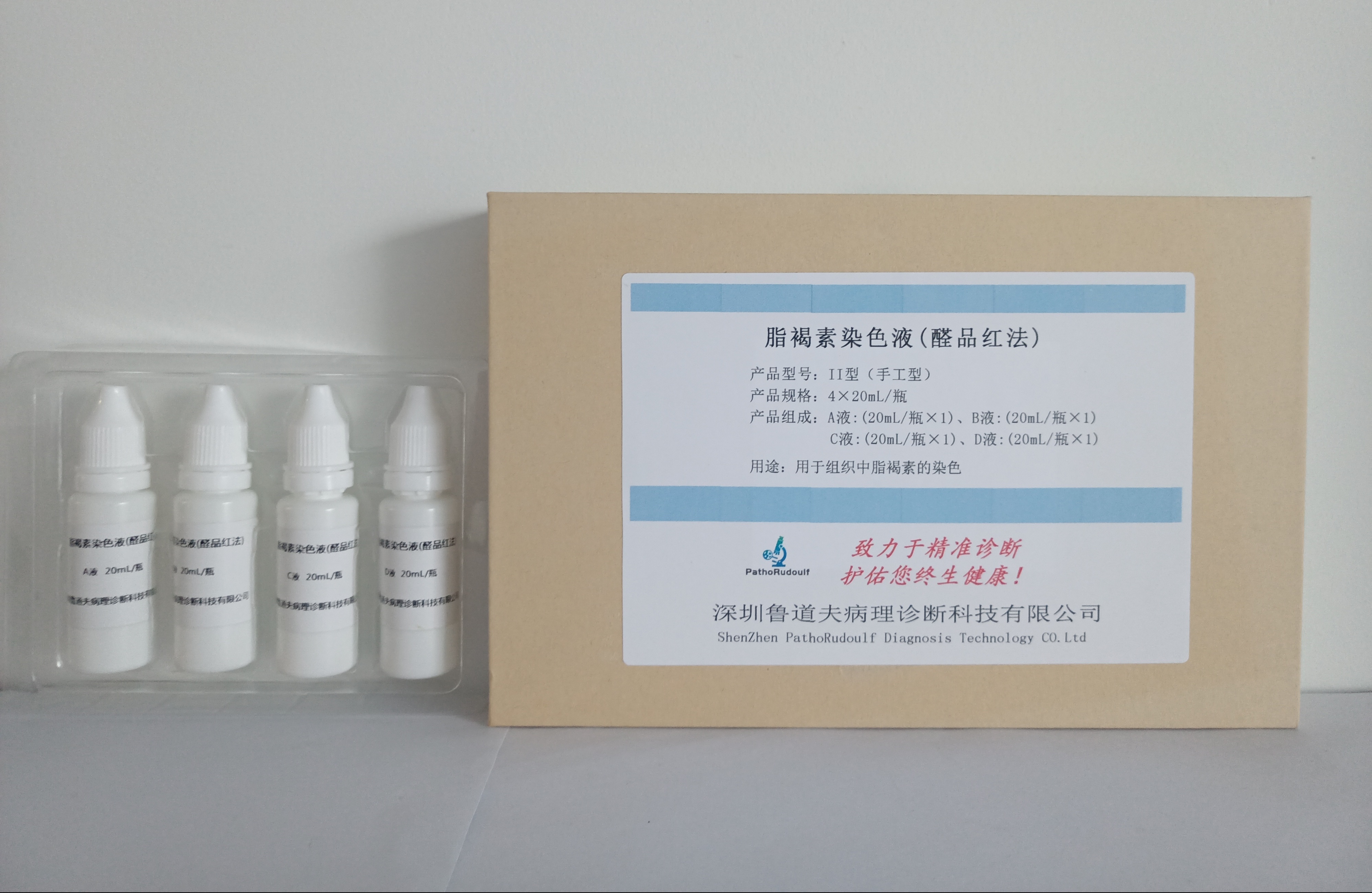
Lipofuscin is a tawny pigment with a granular consistency, composed of fat-containing residues and lysosomal digests, and is thought to be produced by the oxidation of lipids and lipoproteins; the process of lipofuscin oxidation occurs slowly and progressively, and the pigment therefore exhibits different staining reactions, different colors, and variations in shape and size. Lipofuscin can be found in liver, kidney, heart muscle, adrenal gland, nerve cells and ganglion cells, etc. It is mostly distributed around the cell nucleus.
Since lipofuscin is formed gradually by the slow oxidation of lipids and lipoproteins, and the pigment is at different levels of oxidation, the histochemical reaction will be different when applying techniques to confirm that the pigment is lipofuscin, so it is recommended to apply a number of different techniques to verify that the pigment is lipofuscin. Some of the commonly used methods are the PAS method, Schmorl's high iron - ferricyanide reduction method, Long Ziehl-Neelsen method, Gomori aldehyde reddening method, and Masson-Fontana silver method.





 0752-2228195