Connective tissue is narrowly defined as the three types of fibers it contains: collagen fibers, reticular fibers, and elastic fibers. Elastic fibers (Elastic Fiber) are mainly distributed in the arterial wall, alveolar wall, and skin of the human body, and are yellow and refractive when fresh.
Elastic fiber staining can show the changes of elastic fibers in skin tissues, such as elastic fiber nevus, skin ring granuloma, hardness disease, etc.; display and determination of endocardial and arterial lesions, observation of certain lesions whether accompanied by elastic fibers hyperplasia or destruction; but also identify the tumor tissue components, such as elastic fibrous tumors, elastic fibers stained by the elastic fibers, elastic fibers in the tumor body can be clearly seen ball. Commonly used elastic fiber staining methods include Gomori aldehyde magenta method, resorcinol alkaline magenta method, lichen red method, Victoria blue method, iron iodine hematoxylin method and so on.
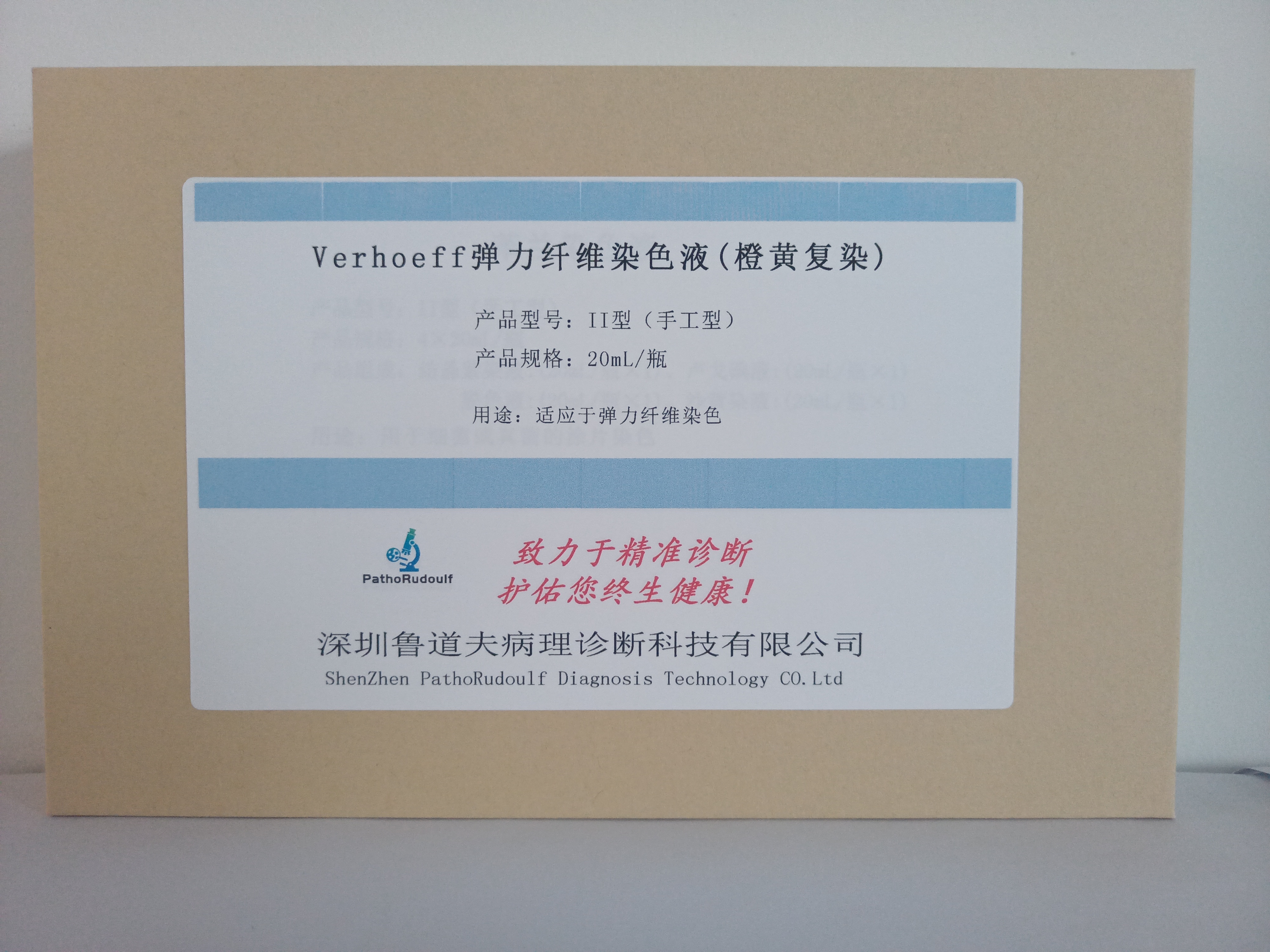
Verhoeff Elastic Fiber Dyeing Solution (Orange and Yellow Re-dyeing) belongs to Iron Iodine Hematoxylin Dyeing Method, and its dyeing principle is that elastin and ex-elastin fibers can be highly cross-linked by disulfide bonds, and after oxidized with iodine, some of the disulfide bonds are transformed into anionic sulfuric acid derivatives, which are strongly alkalophilic, and selectively absorbed by hematoxylin, an alkaline dye in the dyeing solution. This product adopts the improved orange-yellow G compound dyeing method, after dyeing, the coarse fibers have a deeper coloring, the fine fibers have a slightly poorer dyeing effect, the cell nucleus and elastic fibers have a (blue) black color, and the other tissues have a purplish red color, with a clear contrast.





 0752-2228195