Fibroblastic/Myofibroblastic Tumors and Tumor-like Lesions
Applied to sclerosing epithelioid fibrosarcoma;
EWSR1 gene rearrangement was present in 90% (9/10) and FUS gene rearrangement in 10% (1/10).
Tumors and neoplastic lesions of undetermined differentiation
Classical small round cell malignancies mainly include Ewing sarcoma and connective tissue-promoting proliferative small round cell tumor (DSRCT), which are also known as small blue round cell tumors because of the pathologic manifestation of small tumor cells and dark nuclear staining; they straddle the two categories of bone and soft-tissue sarcomas in the classification of bone and soft-tissue sarcomas.
Diagnosis and differential diagnosis of Ewing sarcoma is a difficult task in pathology externals, and often needs to be differentiated from other small round cell tumors, such as neuroblastoma, lymphoma, vesicular rhabdomyosarcoma, pro-fibro-proliferative small round cell tumors, small cell carcinoma, and poorly differentiated synovial sarcoma.
In >90% of Ewing sarcoma patients (mostly under 20 years of age), the EWSR1 gene can be broken and fused to multiple genes; e.g., fusion with the FLI1 gene (85%) and fusion with the ERG gene (10%). According to the WHO 2019 version of staging, tumors with EWSR1 or FUS rearrangements can be classified into two types based on their fused partner genes: those with EWSR1 or FUS genes fused to ETS family transcription factors are defined as Ewing sarcomas; and those with EWSR1 or FUS fused to non-ETS partner genes are defined as "small round cell sarcomas with EWSR1-non-ETS fusions," eliminating the previous definition of Ewing family tumors.
The molecular genetics of Ewing sarcoma is more complex. In addition to FLI1, many minor partner genes belonging to the ETS transcriptional family, such as ERG, ETV1/4, and FEV, can also form fusions with EWSR1 or FUS, and are also included in Ewing sarcoma.
For "small round cell sarcoma with EWSR1-non-ETS fusion", the fusion partner genes of EWSR1 or FUS are commonly NFATC2, PATZ1, and VEZF1. In terms of epidemiology, patients with FEV and NFATC2 fusions were older and had a higher proportion of extraosseous lesions compared to classical FLI1 fusions. In terms of overall prognosis, non-FLI1 fusion sarcomas had a higher rate of metastases detected at initial treatment and shorter overall survival compared to classic FLI1 fusions.
In addition to EWSR1 or FUS rearrangements, some small round cell tumors such as BCOR-CCNB3 and CIC-DUX4 [34] were previously classified under the name of Ewing family tumors. However, according to the WHO 2019 version of typing, these two genetically abnormal tumors were listed separately from the Ewing family tumors and named under the fusion gene name alone.
In addition, EWSR1 fusions with a variety of partner genes are seen in mucinous liposarcoma, pro-connective tissue proliferative small round cell tumors, angiomatoid fibrous histiocytomas, clear cell sarcomas, extraskeletal mucinous chondrosarcomas, soft tissue myoepithelial tumors, some round cell/mucinous liposarcomas, and malignant mesotheliomas, and also in some tumors of non-soft tissue origin such as vitreous metaplasia of the salivary gland clear cell carcinoma, cutaneous sweat gland adenoma, salivary gland mucoepidermoid carcinoma, acute myeloid leukemia, pre-B-cell acute lymphoblastic leukemia, and matricellular plasmacytoid dendritic cell tumors.
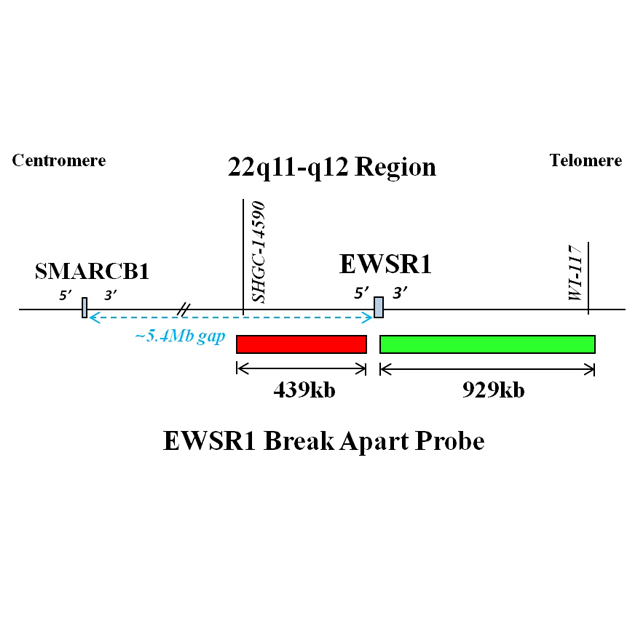
Note that EWSR1 has multiple partner genes and is associated with a variety of tumors. Fusion gene probes for EWSR1, such as WT1, ATF1, CREB1, FLI1, etc., are added when necessary to identify tumors similar to Ewing sarcoma, such as connective tissue-promoting proliferative small round cell tumors, especially in small puncture samples.
Other solid tumors
Fusions of EWSR1 with multiple partner genes (PBX1, ATF1, POU5F1, and ZNF444) can occur in myoepitheliomas/mixed tumors, and EWSR1 breakage probes are helpful in the diagnosis/differential diagnosis of these tumors (~50% positivity rate);
FUS translocations (involving multiple partner genes) and PLAG1 translocations are also present in this tumor;
Myoepithelioma The differential diagnosis is more varied. Soft tissue myoepitheliomas with mucinous stromal changes need to be differentiated from ossifying fibromucinous tumors, extraosseous mucinous chondrosarcomas, and epithelioid Schwannomas.





 0752-2228195