Lymphoma
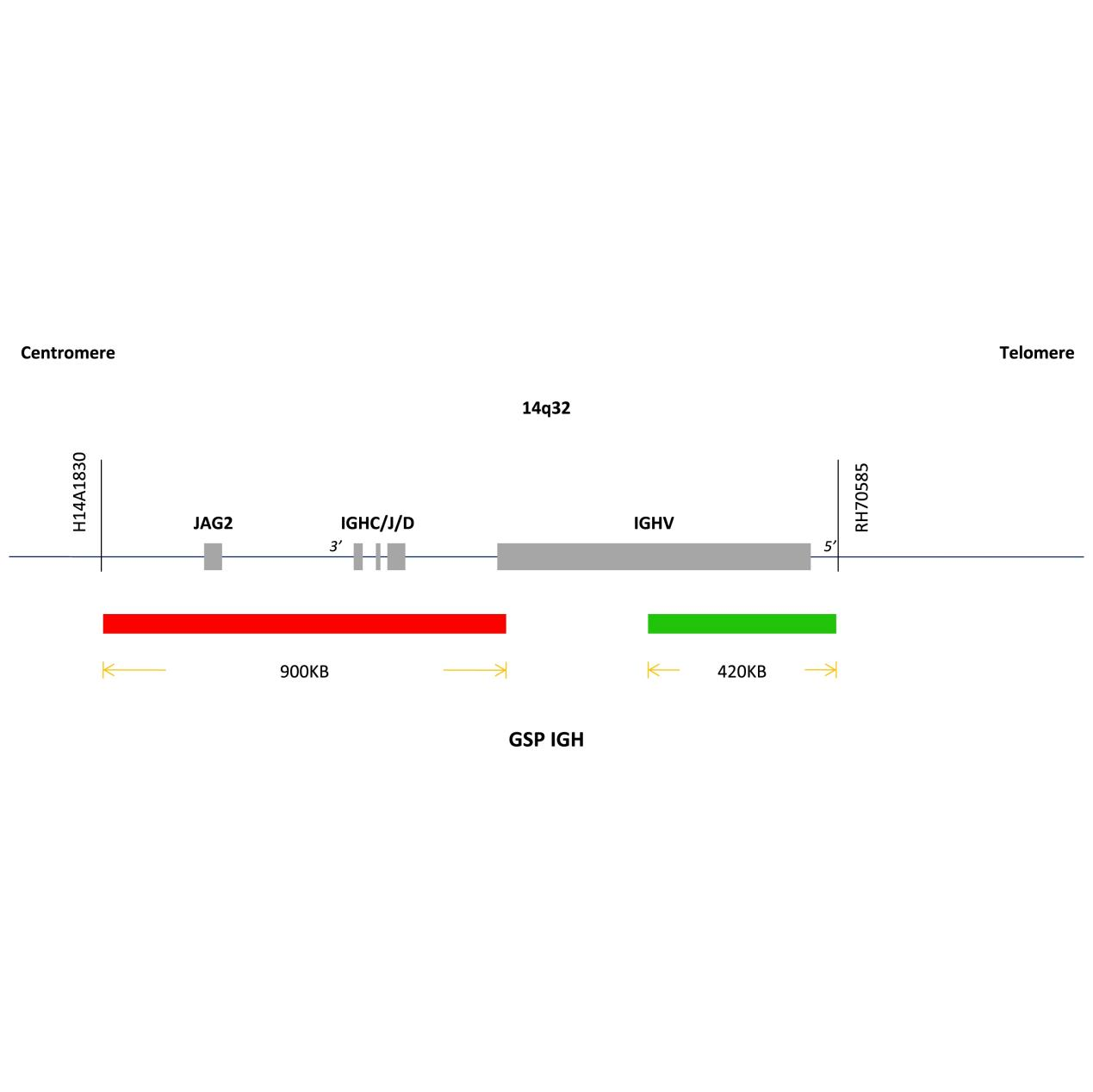
IGH gene is located at 14q32, IGH breaks and translocations occur in 50% of B-cell NHL and in many other lymphoma types, and can be reciprocally translocated with more than 50 genes;
Fusions of the IGH gene with a variety of partner genes can be used for diagnostic purposes, especially in B-cell and T-cell NHL, non-classical HL and reactive hyperplasia that cannot be characterized histopathologically and immunohistochemically. These tests may help to confirm the diagnosis of the disease;
Most of the breakage sites of IGH in DLBCL are concentrated between IGHM and IGHD, which show typical positive signals of 1 red, 1 green, and 1 yellow when using our breakage probes, but when using probes of other companies, we need to pay attention to whether the design of red or green end of the probes is spanning over this region, and it is easy to run into the atypical positive signals when it is spanning over.
Acute Lymphoblastic Leukemia (ALL)
In ALL, IGH and C-MYC have the highest rate of reciprocal translocation. Abnormal translocations of IGH to other genes are also more common in T-ALL and B-ALL.
Multiple myeloma (MM)
The types of IGH gene breaks and translocations are complex, involving a variety of genes, and are commonly found in ALL/MM/lymphoma;
It can be used to detect whether there is an abnormality in the IGH gene and the detection of tiny residual foci;
The IGH gene breaks can be used as a marker for the malignant cloning of myeloma cells, and independent of the clinical staging and the type of immunization, it can be used as one of the favorable bases of confirming the diagnosis of MM.





 0752-2228195