



 0752-2228195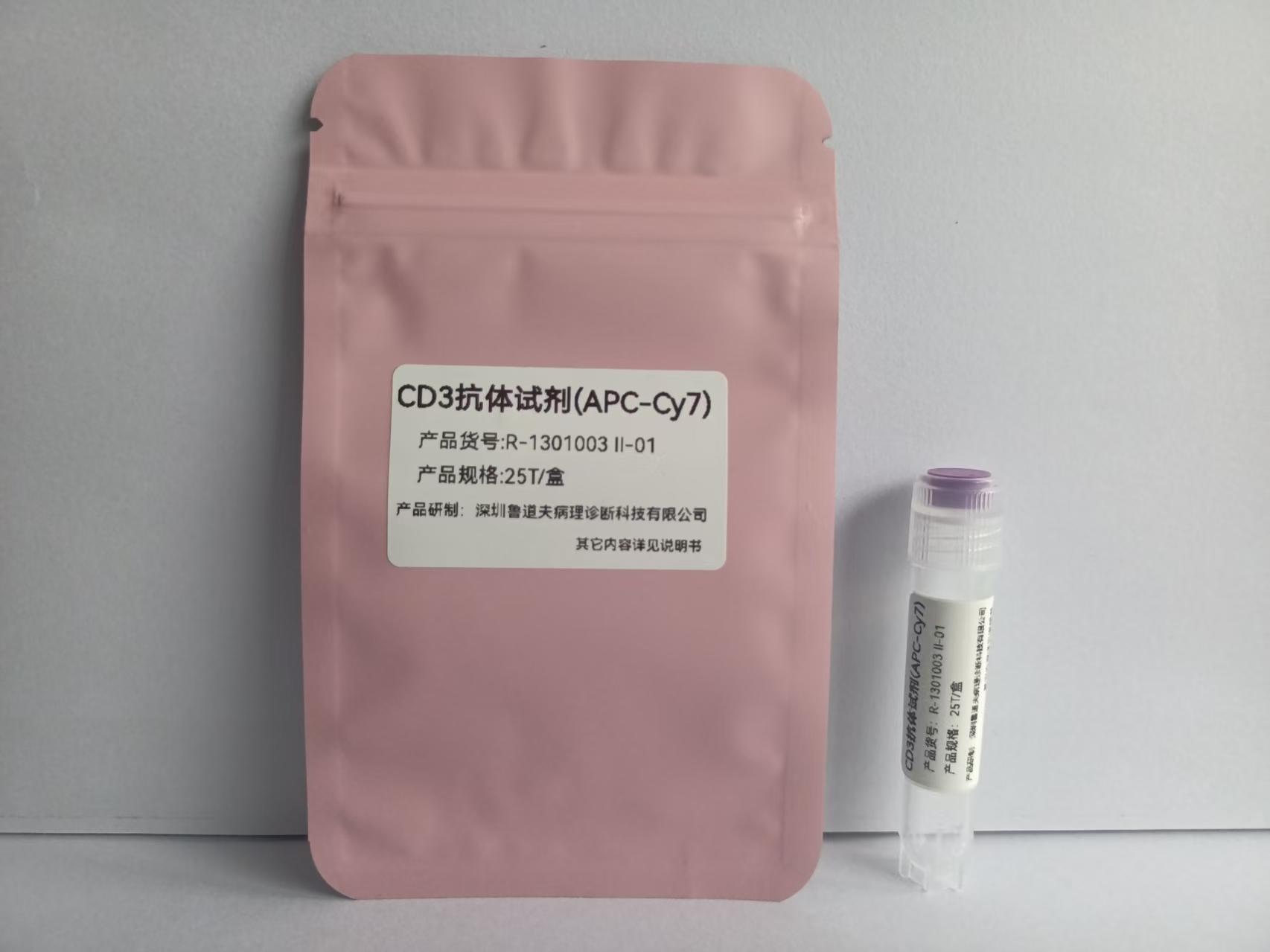
CD3 antibody reagent (APC-Cy7)
Wholesale Price(RMB) :
1238/1010/11282530/2242/2508
Product Code:R-1301003Ⅱ-01/R-1301003Ⅱ-02
File Number:

1238/1010/11282530/2242/2508
| Product Name | Anti-Human CD3, APC-Cy7 Assay Kit |
|---|---|
| Target | CD3 |
| Label | APC-Cy7 |
| Instrument | Flow cytometer compatible with 633nm laser |
| Subtype | Mouse IgG1, κ/Mouse IgG2a, κ/Mouse IgG2a, κ |
| Clone Number | HIT3a/SK7/OKT3 |
| Recommended Application | Flow cytometry |
| Dosage | 5 μl/Test |
| Purification | Affinity chromatography |
| Stock Solution | Phosphate buffer solution containing 0.2% BSA and 0.02% ProClin950 (pH7.2) |
| Storage Conditions | Store at 2 - 8℃, protect from light, do not freeze |
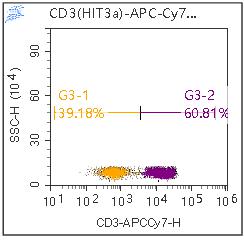
Figure - Results of human peripheral blood staining for Anti-Human CD3, APC-Cy7 (Clone:HIT3a). Lymphocytes from FSC/SSC were used as gates for analysis.
CD3 Molecular Target Information Overview
Molecular Name: CD3 molecule
Gene Family: The Cluster of Differentiation (CD) family of molecules, together with the T-cell receptor (TCR), form the TCR-CD3 complex, a core component of immune signaling.
Synonyms: CD3 complex, T-cell surface glycoprotein CD3, TCR-CD3 complex
Formerly known as: T3 complex (OKT3 antibody target), Leu4 (flow antibody code), T-cell surface antigen T3
CD3 molecular target overview
There are three isoforms, CD3σ, CD3ε, and CD3γ, and the molecular weights of CD3σ and CD3ε are 20 kD. CD3σ and CD3ε have a molecular weight of 20 kD, and CD3γ has a molecular weight of 26 kD. It is expressed in T lymphocytes, thymocytes and NK cells. It is expressed on 61%-85% of normal peripheral blood lymphocytes and 60%-85% of thymocytes. It belongs to the immunoglobulin superfamily with unknown ligands.
CD3 is a component of the T-lymphocyte receptor (TCR) complex and forms a complex with the α/β and γ/σ T-lymphocyte receptors (TCRs), which are the major membrane antigens for transducing peptide/MHC-bound TCR signals.TCRs are essential for cell surface expression, antigen recognition, and signaling.
Monoclonal antibodies to CD3 can induce or block T lymphocyte activation. In the presence of anti-CD28 antibody or IL-2, anti-CD3 antibody induces apoptosis in T lymphocytes.
CD3 is one of the best markers of mature T-lymphocytes in the peripheral blood, and the determination of CD3+ T-lymphocytes is important for evaluating the typing and diagnosis of immunodeficiency disorders (T-lymphocyte deficiencies), leukemia, and lymphoma (T-lymphocyte type). In addition, anti-CD3 monoclonal antibody can be used for immunosuppressive therapy at the time of organ transplantation or bone marrow transplantation, as well as for immunomodulatory therapy in severe autoimmune diseases to remove T lymphocytes.




Copyright: Shenzhen Rudolf Pathological Diagnosis Technology Co., Ltd