Rhabdomyosarcoma
SRF-NCOA2 and TEAD1-NCOA2 fusion genes can occur in spindle cell rhabdomyosarcoma, and NCOA2 gene breakage probes are helpful in the differential diagnosis of this type of tumors;
Applied to Softtissueangiofibroma (STRAFFOMA);
STRAFFOMA has a repertoire of fusion genes AHRR-NCOA2 and GTF2I-NCOA2;
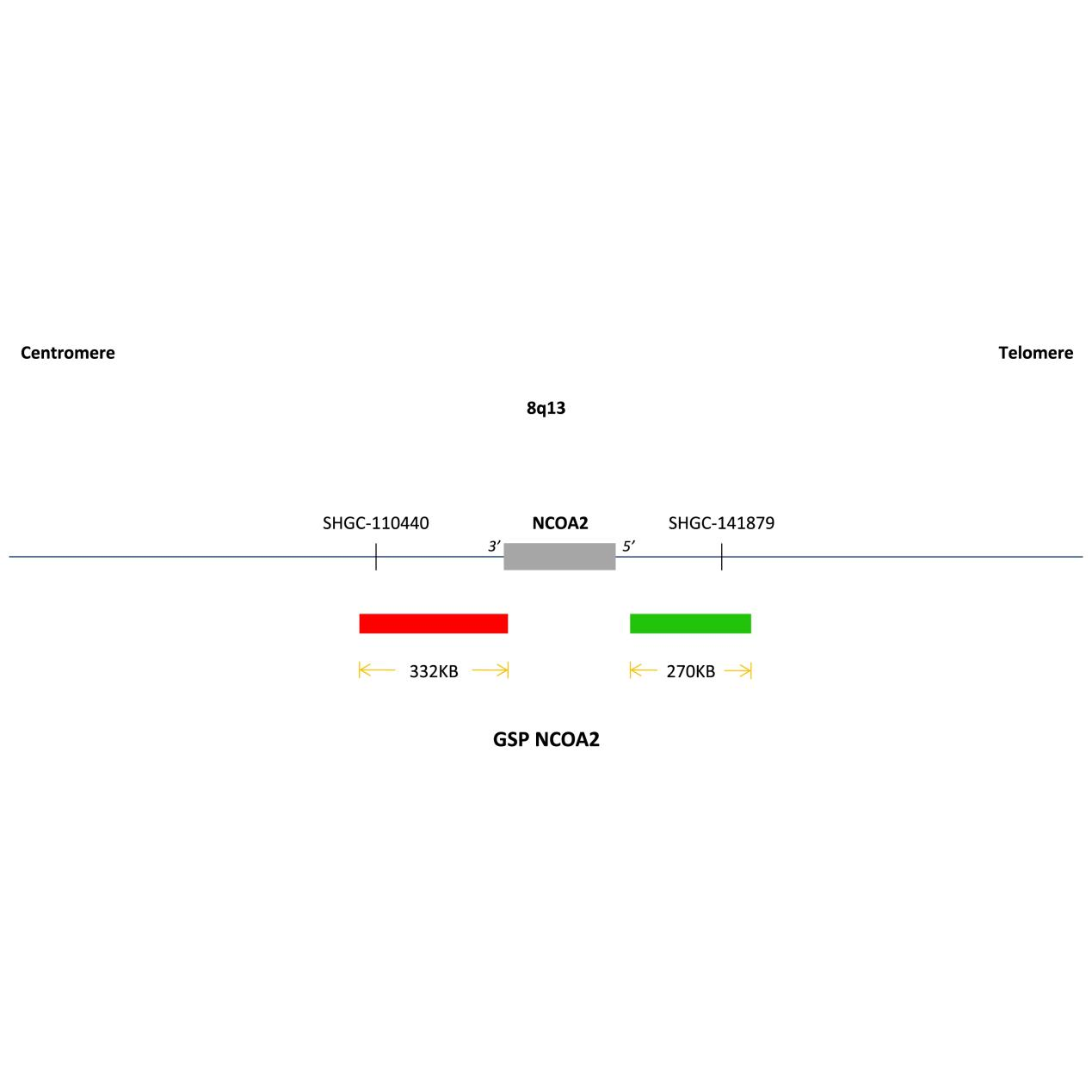
is designed as an NCOA2 gene breakage probe for aid in diagnosis;
Soft tissue osseous-chondroid tumors and verrucous lesions
Application to Soft tissue angiofibroma (soft tissue angiofibroma), which has the recurrent fusion genes AHRR-NCOA2 and GTF2I-NCOA2; designed as an NCOA2 gene breakout probe for adjunctive diagnosis.
The HEY1-NCOA2 gene fusion manifested as an in-frame fusion of exon 4 of HEY1 and exon 13 of NCOA2 at the mRNA level, with HEY1 and NCOA2 localized at 8q21.1 and 8q13.3, respectively, at a spacing of about 10 Mb. Therefore, the FISH test results should be interpreted with great care. This gene fusion occurs in almost all mesenchymal chondrosarcomas and is absent in other subtypes of chondrosarcomas, and has a high specificity for the diagnosis and differential diagnosis of mesenchymal chondrosarcomas.
Note: In mesenchymal chondrosarcoma NCOA2 gene can be fused with HEY1, which can be detected by PCR + sequencing. However, it cannot be detected by FISH method because the two are only 8M apart in the genome and it is not easy to distinguish negative/positive signals, which may lead to misdiagnosis. When only a round cell component is seen in small biopsies of mesenchymal chondrosarcoma, it needs to be differentiated from small cell osteosarcoma, Ewing's sarcoma and other round cell sarcomas that are differentiated.





 0752-2228195