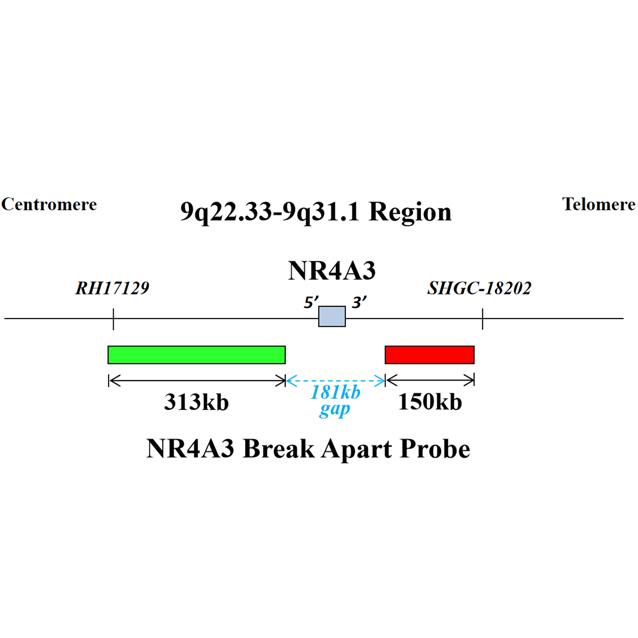
It can be used as an adjunctive diagnosis for extraosseous mucinous chondrosarcoma and salivary gland vesicular cell carcinoma. Extraosseous mucinous chondrosarcoma with EWSR1-NR4A3 fusion needs to be differentiated from a variety of other small round cell sarcomas with mucinous transformation, which may also be associated with EWSR1 fusion with other partner genes. Therefore, the EWSR1 breakthrough probe alone is not sufficient to identify extraosseous mucinous-like chondrosarcomas, and an additional or specialized NR4A3 breakthrough probe is required. Also in 2019, AJSP reported that NR4A3 immunohistochemistry and FISH in salivary gland alveolar cell carcinoma are effective differential diagnostic markers to differentiate alveolar cell carcinoma. The authors enrolled 64 cases of adenoalveolar cell carcinoma (including 17 high-grade transformations) and compared them with 29 cases of mammary secretory carcinoma (MASC) and 70 cases of other salivary adenocarcinomas. In alveolar cell carcinoma, NR4A3 immunohistochemistry was 100% specific and 98% sensitive, while FISH was slightly less sensitive (84%). No NR4A3 immunohistochemistry or FISH translocation positivity was found in MASC and other salivary adenocarcinomas. The authors concluded that NR4A3 immunohistochemistry is a highly specific and sensitive marker, especially in cases with high-grade transformation and “zymogen granule” (which is more difficult to distinguish from MASC).





 0752-2228195